Auger Electron Spectroscopy (AES) provides quantitative elemental and chemical state information from surfaces of solid materials. The average depth of analysis for an AES measurement is approximately 5 nm. Physical Electronics Auger instruments provide the ability to obtain spectra with a lateral spatial resolution as small as 8 nm. Spatial distribution information is obtained by scanning the micro focused electron beam across the sample surface. Depth distribution information is obtained by combining AES measurements with ion milling (sputtering) to characterize a thin film structure. The information AES provides about surface layers or thin film structures is important for many industrial and research applications where surface or thin film composition plays a critical role in performance including: nanomaterials, photovoltaics, catalysis, corrosion, adhesion, semiconductor devices and packaging, magnetic media, display technology, and thin film coatings used for numerous applications.
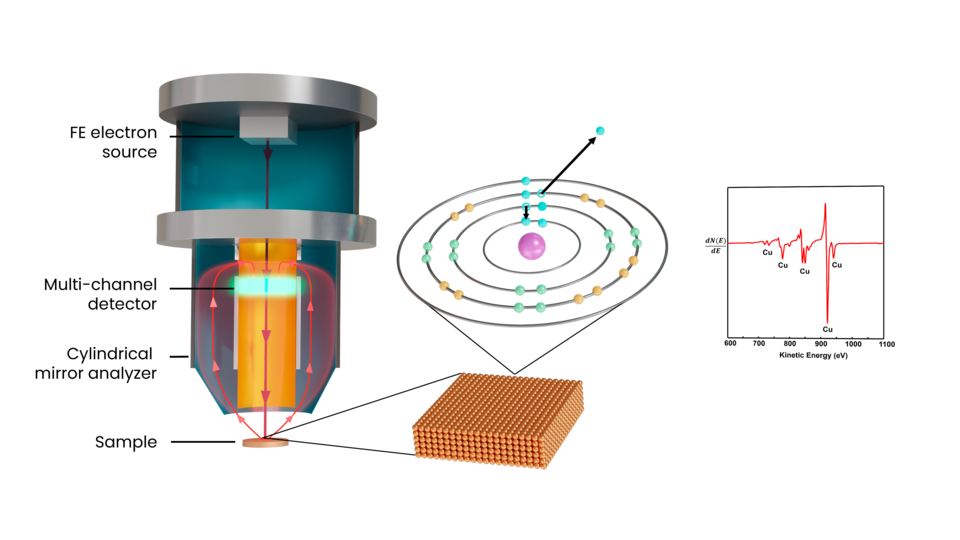
AES is accomplished by exciting a sample’s surface with a finely focused electron beam which causes Auger electrons to be emitted from the surface. An electron energy analyzer is used to measure the energy of the emitted Auger electrons. From the kinetic energy and intensity of an Auger peak, the elemental identity and quantity of a detected element can be determined. In some cases chemical state information is available from the measured peak position and observed peak shape.
Physical Electronics AES instruments function in a manner analogous to SEM/EDS instruments that use a finely focused electron beam to create SEM images for sample viewing and point spectra or images for compositional analysis. In contrast to SEM/EDS which has a typical analysis depth of 1-3 µm, AES is a surface analysis technique with a typical analysis depth of less than 5 nm and is therefore better suited for the compositional analysis of ultra-thin layers and nanoscale sample features.